70 degrees two days ago, temps are now in the 50's on a daily basis. That can mean only one thing - Spring WILL actually make an appearance this year. I'm going to try tomorrow to get my first fish of the year at a local pond. That should also mean the end to the series of non-fish catching posts that comprise the Winter on the blog.
I wasn't sure I'd make it through this winter, but like a big batch of skunk cabbage, I feel like I'm rising through the muck, awakened by the optimism of yet another Spring.
Keep your eyes peeled for 2009's fishing adventures!
Wolfy
Thursday, March 19, 2009


Thursday, March 5, 2009
Traveling with your rods
This is actually a two part post, which I only realized when I sat down to type it. The original intent is to pass on a "Helpful Hint" about packing and sending rods in rod tubes. I'll get to that in a second. But I started thinking about something else, in the same travel vein.
When most of us begin fishing, we start with a 2-pc., relatively cheap rod. When we progress to a level where we can discern the difference between rods, we usually gravitate toward one-piece rods. If I have 50 spin and baitcast rods at home, 45 of them are 1 piece, and I don't think that ratio is uncommon. So - why don't we use 2 pc. (or multi-piece) rods? It used to be that the ferrule technology just wasn't up to speed, and the ferrule (connection point) was the weak point of the rod. If so, why are the most expensive fly rods in the world 3, 4, or 5 pieces? Fly fishermen - myself included - won't stand for rods that don't perform, especially at the price of a premium rod. So - why the reluctance from baitcasters and spin fishermen to use 2 or 3 piece rods? They ARE easier to transport.
I think a lot of it has to do with the fact that many fishermen buy a rod, put it in the rod locker of their boat, and don't have any other issues to deal with. If they go somewhere to fish, they take their boat. But what about the traveling fisherman - going to Canada on fly-in, Bahamas for bonefish, ... My thought is that they simply don't know that there are very good quality 3 piece rods on the market. They might not be easy to find, but they're out there. One company who makes terrific 3-pc rods (and I know from experience - I own 4 of them) is St. Croix. I've used their 3-pc rods for smallmouth, pike, bonefish, tarpon and had NO problems. The ferrules and rod flex not noticeable - unless someone told you, you would never know you were fishing a 3 pc rod. And - they are EASY to transport.
But back to my original thought - taking along 1 piece rods on a plane. There are a few pointers you should follow to reduce the possibility of the Airport Baggage Beasts ruining your trip. I use either a Plano 45102 or a Plano 6508 for my trips. The 45102 is 4-1/2" inside diameter and will hold up to 8 rods comfortably. the 6508 is 6-1/2" inside and will easily hold a dozen rods. It has wheels for ease of transport.
1) Put padding on the bottom of the tube, and some around the top of the rods. Split the rods in half, so the tips of half are paired with the butts of the other half.
2)Next I wrap the rod bundles with some clothing for the trip. Saves on room in the suitcase and protects the rods.
3) Have the tube extended 4"-6" longer that the bundle of rods. Have a dowel rod cut about 3" longer than the rod bundle, and put it in the tube with the rods. The worst thing that can happen to a tube is for the piece that secures the extension to fail, causing the tube to collapse and break all the rods. IF that happens, and you have the dowel inside, it won't allow the inner part of the tube to collapse and will save your rods.
4) Duct tape the collar noted in 3 above to further reduce this possibility (Part A in the photo)
5) After checking the tube at the airport, ask to secure the top after it is inspected, if they need to. I tape a half dozen long plastic security ties to the inside of my tubes. Take one of them out (or tell the TSA where you have them) and zip-tie it shut. (Area B below)

I travel with my rods extensively and have never (knock on wood) had a problem by doing this.
Hope this helps on your journeys!
Wolfy
Thursday, February 5, 2009
Committing to learn a new pattern in 2009
This is something I was going to post as a New Years resolution, but never got around to posting. I consider myself a pretty good, versatile fisherman when it comes to bass fishing. Rivers, lakes, largemouth, smallmouth, spots, tidal water - I'm fairly comfortable with all these options. But I recently realized that I have not kept up with a lot of the newer tactics - drop shotting, for example. Since I don't fish tournaments anymore, it doesn't really matter to anyone except me. But I have a lot of lures that I rarely use. So, I wantto try to get comfortable with at least one of them this year and expand my comfort zone on the water.
One of my goals this sumer will be to do more mid-depth crankbaiting. The 5' - 15' deep range. I almost always fish this type of water with some sort of plastic - a swimbait, grub, fluke. One of the big reasons for my lack of experience in this type of fishing is simply that I don't have any waters nearby that have that type of depth. Most of what I fish locally are shallow (5' max) ponds. Still, I have a few waters where I can give these mid-range crankbaits a try. So, I made a quick look through a box of baits and came up with some ideal trial baits. The following will be my arsenal for this experiment.


Strike King Series 3 and 4S, LC GD3 mini LC Staysee 90 SP, Flat CB 14, 20


Rapala DT 4, 6, 7 Rapala Minnow Rap 7, 9, Storm Jr. T-stik
I know that the only way I'll realy get a good feel for these baits is to take them out exclusively and fish them all day. I guess I'll just have to leave the topwaters / spinnerbaits / plastics at home. Year's ago, when I was first learning to fish worms, I did the same thing - went on the water with only worms. It was tough, but it worked. In the end it just made me a better, more versatiel fisherman.
One bait I am really looking forward to using this year is one I experimented with briefly last year. The Rapala Sub-Walk was introduced LY. It is a slowly sinking "Walk-the-dog" style baits - a subsurface Zara Spook, if you will. In clear water, it is a really fun site bait - the pike in Ontario absolutely mauled it, even if they were small. I didn't get a chance to try it for bass and I think it will be great.
That ought to do it for now - until we lose the 15" of ice and 8" of snow, open water fishing will just be a dream. I'll have to be content with sharpening hooks and re-spooling reels. Can't wait for the spring.
 Rapala Sub-walks
Tuesday, January 27, 2009
Snow, Cold, nasty - YUK
I really like winter - I always have. We lived in Syracuse NY for 10 years before the 8 months of snow they get there annuallyfinally burned us out. But this winter seems like the worst ever. It's REALLY cold - we've seen -25 and a lot of sub-zero this winter. It never seems to get above freezing. And I just don't seem to be into ice fishing this year.
I think I'm getting old.
Anyway - only a little longer before the open water fishing starts. I can't wait!
I think I'm getting old.
Anyway - only a little longer before the open water fishing starts. I can't wait!
Tuesday, January 6, 2009
Knives
I have always liked knives. Probably started as a Boy Scout, when you always had a knife in your pocket and always found something to carve or whittle. Like most of my other stuff, I have way more knives than I need, but, with SHOT Show coming up, I'll probably get a few more. I know a little bit about the knife construction but am by no means any form of an expert. It's sort of like art - if I like it, I like it. I might like the functionality, the weight, the blade structure, or just the way it looks. When I was going throught my knives recently, I took some pictures and thought I'd share them. Some have neat stories, some no story at all.
 A Camillus Yellow Jacket
This classsic pocket knife is known as a muskrat skinning knife with its two long, thin blades. I always liked to use a long bladed knife when rabbit hunting as a youth, and this is my favorite. One of the few I own that are not some form of lock-backs. Sadly, Camillus Knife Co is no longer in business. When I lived in NY, I sometimes would fish in Ninemile Ck against their building for trout!
 Beretta Airlight knives
When I repped Beretta in the early 90's I fell in love with these knives. The stteel is good, the knives are durable, and they are LIGHT. The 1/3 serrated knife shown at the bottom of the photo will do about anything you need a knife to do. At the time , Gary Fadden headed up their knife business at Beretta. Gary is now the President of Al Mar Knives, a maker of truly spectacular knives .
 An Al Mar Hawk w/ Mother of Pearl handle
 An Al Mar Sere folder
Gary's Al Mar knives are treasured by knife lovers around the world. They are terrific knives, no matter how much you know about knives, and you can't help but to appreciate their quality. Seeing Gary and the Al Mar booth at SHOT Show is an annual event for me.

 Victorinox Money Clip
Leatherman showed the world the versatility of the mini-tool, and nearly everyone has some sort of these multi-function pieces today. Over the years I hacve found that the single most useful item on the pieces pictured above is the scissors. I find myself reaching for them more than I could ever imagine. If you don't own something with a scissors, you owe it to yourself to try one of these out.
In 1995 I was a guest on a trip to Norway with Rapala. We started the trip in Rovenimi, Finland at the famous Martiini Knife Co. (which is now owned by Rapala, but was owned by the Martiini family at the time) TRIVIA: What is the largest city in the world NORTH of the Arctic Circle? Rovanimi, Finland! The Martiini family were terrific hosts, and they gave us some very nice knives as mementos. We could also buy knives if we desired. The following are from that trip.
 A pair of curly birch handled knives - one filet and one hunting - that go into one dual sided tooled sheath
 A high carbon steel hunting knife. This is one of their earliest models. The carbon content in the steel makes it relatively easy to hone to a razor edge, but the knife dulls more quickly than harder steels.


This rosewood handled filet knife has a bronze salmon head on the end of the handle.
So - what do I normally carry in my pocket? An old, beat up Buck folder! Go figure.
got any knife likes or dislikes??
Wolfy
Wednesday, December 31, 2008
Year in Review, looking forward to 2009
Happy New Year's Eve to all. It's time for the requisite review of the past year, and looking into the crystal ball for 2009.
My 2008 from a fishing perspective was one of my best ever, on a few different levels. I caught fish in 2 more states in my quest for a fish in all 50 states (Oklahoma and Iowa), went on my first family extended fishing tri with my Dad, brother, and son (Shoal Lake in Ontario), and did my most exotic trip, and one of the best trips I've ever taken - Tropic Star Lodge in Panama. I got my hoped-for trophy roosterfish - estimated at 70-75 lbs, as well as my first billfish. I ended up catching 28 different species of fish this year. So, I have nothing to complain about, only experiences to be thankful for. Here's a few of my fish from 2008
 Trophy roosterfish - 64", 70 lbs. +
 Cubera Snapper!

My first billfish - a Pacific Sail

A nice Alabama largemouth
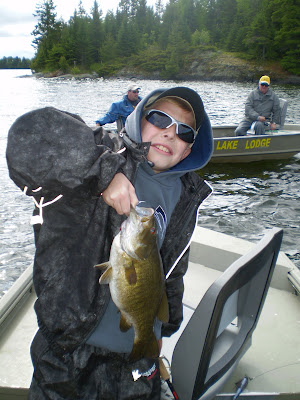 My son Joey with a chunky Ontario smallmouth
 Mississippi River smallmouth

Colorado brookie on a hopper
For the coming year, I don't have anything as exotic as Panama planned. I'm hoping to go back to my favorite pike lodge in August - Blackmur's Athabasca Lodge in far northern Saskatchewan. I'd also like to get my son down to Alabama with me in the spring - terrific bass and brim fishing. As always, I'll try to get in more fly fishing for trout, but will probably struggle to do so - Illinois is just too far from any good trout fishing, except SW Wisconsin. I'd like to knock off another state or 2 on my list. I have a myriad of new crankbaits, and love to fish them, but rarely do - I'll try to utilize these baits more in 2009.
So - right now I'm looking forward to panfish when the ice breaks, big pike in summer, and whatever else comes my way. No matter what the outcome, it shouldn't be dull.
Best wishes to all of you in 2009
Wolfy
Sunday, December 28, 2008
Tough day on the Delta, and a Merry Christmas to the WORLD!
Well, I got my last day of fishing in for 2008 . The week before Christmas, I braved a snowstorm here in Chicago (took 4-1/2 hours to drive the 50 miles to the airport - usually takes an hour), spent the majority of the afternoon/ evening watching delays and cancellations pop up on the flight status boards, finally got on a plane, and got to San Francisco Airport at 2 AM (original time to land was 8 PM). The next morning, I met Lennie and we were off for a day on the Delta.
 A classic delta spot - water flows on the tidal changes from the channel to the pond and back
The Delta in question is the Sacramento River Delta, a vast series of creeks, sloughs, ponds, lakes and marsh grasses that eventually feeds into the San Francisco Bay. It's one of those places - like the mazes of mangroves in SW Florida - that would be nearly un-navigable without a GPS. I feel like I have a very good "inner compass", but I am lost on the Delta from minute we leave the marina until we return. It's Lennie's home waters, though, and since he's the Hummingbird rep, his boat is outfitted with all the good toys!
 The Jigging Spoon we finally caught some fish on!
This area can get fairly cool in the winter, but rarely gets downright cold. Well, I brought Chicago's weather along with me , because it was freezing cold the day I was there. I wore 2 layers of Under Armour, one of them being Coldgear, a layer of fleece, a sweater, and a windproof jacket. Gloves, a full facemask, and a helmet when running the boat. Still froze. A constant wind kept us company, and the temp never got above 36. It had frozen the puddles the night before - pretty uncommon for this area. And, worst of all, it dropped the water temps to the low 40's. We were fishing for stripers that come up out of the Bay, and with the water temp as cold as it was, they simply didn't show themselves. We fished all day, I got 1 striper on a swimbait, and we finally found a group of fish on the electronics late in the day that allowed us to vertical jig spoons for them. Three schoolie stripers, a few short strikes, and 2 carp on the spoons rounded out the day. Yes, the carp HIT the spoons. I'd never gotten them on spoons before, but have caught them fairly often on jigs. I lost one big fish that we weren't sure was a carp or striper, estimated 20#. Since neither of us saw it, we decided it must have been a striper! (Poetic license being used, since I'm the blog writer. Actually, I don't care what it was - it pulled hard for the minute or so it was on).
 Len's Carp on a jigging spoon

Our stripers from the Delta
For those not familiar with the Delta, it is absolutely filled with birds of all kinds. this is prime waterfowl season, and we saw a number of hunters. The air and trees / shrubs are full of raptors, too. Flocks of Sandhill Cranes are constantly on the move, and in the afternoon, uncountable numbers of Snow Geese were on the move from their feeding fields to the water. It's a truly astonishing place, even if I was freezing my butt off - did I mention it was cold?
So, we had a tough day of catching (a gross understatement) but, even with the trying conditions, it was another great day to be out. The only consolation came that evening, when Len called me to say he had talked to Bobby Barrack (the Dean of the Delta Guides) and Bobby had worked hard wit a client for 3 stripers. Some days, that's how it goes.
I hope everyone had a very Merry Christmas and is looking forward to a wonderful 2009. All the economic doom-and-gloom aside, I can't wait to see what 2009 brings. It's the eternal optimist in me, I guess.
Wolfy
Tuesday, December 2, 2008
100 species of fish caught - thanks Ben!
As you can see in my previous post, I tried to write down all the species of fish I've caught. I say "Tried", because I missed one. Ben from Madison asked I had ever caught a Lake Trout. Well, I've caught Lake Trout in Skaneateles Lake in NY, Lake Ontario, Athabasca Lake in Saskatchewan, and numerous lakes and rivers in south central Yukon. So - there it is - 100 species!!
Thanks for reminding me, Ben.
Thanks for reminding me, Ben.
Sunday, November 30, 2008
Thanksgiving, Life list

This fish is commonly called a Lion Fish, but is also known as a TURKEY Fish. I figured it was appropriate as a lead-in for a Thanksgiving post.
Well, Thanksgiving has come and gone. It's snowing outside right now in northern Illinois. My late season pond fishing was thwarted this year by ice - we've had thin ice on the ponds for the past week and a half. A few years ago, on the day before Thanksgiving, I caught 6 nice largemouth in the pond across the street with 1/8 oz. Strike King Bitsy Jig and Craws. This year, those jigs wouldn't have made it through the ice. I still have one fishing opportunity this year to look forward to - I'm planning on fishing a day on the Sacramento River Delta a week before Christmas. The plan is to be there when the big stripers come in, but the fish don't always listen. Even if they're scarce, there are always stripers and largemouth willing to bite a swimbait.
I have a lot to be thankful for, even in these trying economic times. I have a job that I love, it's in the Fishing/ Outdoor Industry, a terrific family, I get to watch my 11 year old son grow up, - not bad at all.

My son, Joey, with a nice smallmouth from Shoal Lake , ONT, this past summer
Anyway, I've had a nagging urge to come up with a LIFE LIST of species caught. I just read Ben's list on his blog ( http://www.benfishinglog.blogspot.com/ ) and it motivated me to try to put mine together. A couple of issues arose for me: 1) I don't know that much about species of panfish, so I only put down the ones I know for sure, and 2) one of the things I really like to do is fish off the bridges in the Keys when the winds blow too hard to get out on a boat or wade for bonefish. I fish light, and have caught a myriad of "aquarium fish". Don't know what 90% of them were from a technical standpoint, but they were neat. So - they weren't counted.
The recalling of the list is fun, and now that its been done, I can add to it when I catch something new. Also - I counted 99 species, so 100 will be a milestone. I think 100 is pretty attainable if you fish primarily SW, but I am primarily a FW guy with occasional forays into the brine.
FRESHWATER (58) :Rainbow Trout, Brown Trout, Brook Trout, West Slope Cutthroat, Greenback Cutthroat, Bonneville Cutthroat, Yellowstone Cutthroat, Coastal Cutthroat, Dolly Varden, Grayling, Landlocked Salmon, Atlantic Salmon, King Salmon, Steelhead, Inconnu, Lake Whitefish, Mountain Whitefish, Coho Salmon, Largemouth Bass, Smallmouth Bass, Spotted Bass, Wiper, Bluegill, Redear Sunfish, Brim, Pumpkinseed, Black Crappie, White Crappie, Yellow Perch, White Perch, White Bass, Yellow Bass, Rock Bass, Fallfish, Musky, Northern Pike, Tiger Musky, Chain Pickeral, Burbot, American Eel, American Shad, Hickory Shad, White Sturgeon, Channel Cat, Flathead Cat, Blue Cat, Yellow Bullhead, Brown Bullhead, Walleye, Sauger, Common Carp, Mirror Carp, Sucker, Quillback Carpsucker, Bowfin, Gar, Sheepshead (Freshwater Drum)
SALTWATER (41): Striped Bass, Sea trout, Sea Bass, Sea Robin, Oystercracker, Stingray, Flounder, Tarpon, Bonefish, Grunt, Barracuda, Rainbow Runner, Lane Snapper, Mangrove Snapper, Cero Mackerel, Black Grouper, Redfish, Sheepshead, Snook, Spanish Mackerel, Ladyfish, Bluefish, Pacific Sailfish, Yellowfin Tuna, Wahoo, Mahi Mahi, Roosterfish, Broomtail Grouper, Cubera Snapper, Jack Crevalle, Amberjack, Lemon Shark, Blacktip Shark, Hammerhead Shark, Sand Tiger Shark, Tautog, Bonito, Skipjack Tuna, Ballyhoo, Spiny Dogfish, Pinfish
99 total, at least that I can recall. Chime in - rack your brain to come up with your personal list. It was fun recalling. Especially on a snowy November afternoon.
Happy Thanksgiving!
Sunday, November 16, 2008
Hunting, Fishing, Outdoor books

As I read over the post I made last week about some of my favorite things, it dawned on me that the impetus for the post never made it into the story, and that it probably deserved a post of its own. I was looking through my books, and pulled out one of my absolute favorites - "The Old Man and the Boy" and "The Old Man's Boy Grows Older", both together under one cover, by Robert Ruark.
I am too young to have read Ruark's columns when he was writing for Field and Stream, first the series of columns that make up the book I've noted, and then his famous series of African safari articles. I have since come to look at Ruark's works as my favorite in all of outdoor writing, eclipsing (for me) even the works of Hemingway, Jack London, and Robert Traver. Much like art and beauty, the quality of the written word lies in the eye of the beholder - there is no right or wrong. Lengthy debates have, and will continue to, arise over the merits and shortcomings of one author over another. These are healthy as debates, but not much more - if you read and enjoy an author, then they are good. Period.
I have nearly everything Robert Ruark has ever written - I believe I'm missing "Grenadine Etching". In my estimation, the book seen above, along with his African Safari books (Use Enough Gun, Horn of the Hunter) secures Ruark's place in hunting's Written Hall of Fame. While "The Old Man and the Boy" stories deal primarily about hunting while growing up in coastal North Carolina (the stories are works of fiction but rely heavily on autobiographical content), a fair amount of these pieces are about fishing experiences - brim on the river, drum on the ocean barrier islands. All are memorable and, if you have not read them, go to your local library and take out a copy, pick up a cheap used copy on eBay, or hunt for one in your local used book store - you will not be disappointed
When my son expressed some interest in hunting at the age of 10, I told him he needed to read "The Old Man and the Boy" first, to understand what hunting was really all about. He read the stories, and still re-reads them, even though he's not a hunter. He loves to fish and finds the same joy in them that I have for years. I hope you do , too.
P.S. - this individual book is particularly near and dear to my heart. The forward in this book is from Peter Capstick who, along with Ruark, is proabably the most famous Safari writer. I met Peter in 1992 and he signed the book to me on the front page of the forward. He died a year later.
Wolfy
Tuesday, November 11, 2008
My Favorite Things
I admit it - I have a LOT of stuff. Working in the fishing and hunting industries for nearly 20 years, and being a compulsive packrat, I have STUFF - lots of it. Rods, reels, lures, flies, boots, ... really, too much of it. The good thing is, when someone at work is going to the Keys for a weekend in Feb., for example, they know they can borrow a fly reel loaded with a bonefish line, and a box of flies appropriate for the destination! Still, with all the stuff, I have my favorite things. I define my favorite things as follows: regardless of the price, or how I came to obtain them (gift, bought them myself), I will NEVER be without them. These are the things that, if I was to wear them out, lose them, break them - I would replace them without a second thought. The following are my Favorite Things. Feel free to comment on yours as well as your thoughts on mine. They are in no particular order.

Muck Boots/ shoes. These are the most recent acquisition that I will never be without. I have both shoes and boots, and they are , without a doubt, the most comfortable footwear I've ever worn. Being neoprene, they are too warm for the summer, but that's the only drawback I can see. I wear the shoes for fishing from a boat - they're waterproof - and the boots for pheasant hunting. The shoes when its cold outside. I also happen to be afflicted with gout about once a year, making walking nearly unbearable. The shoes are the only things I can function with when gout flares up. These shoes/ boots are awesome!
 Fenwick HMG UL spin road, circa 1985. This is one of the first "good" rods I ever bought, and I still use it as much as nearly any rod I own. I love to fish for panfish, so it is usually along with me on my walks around the local ponds. It's too short (4-1/2'), too light and whippy, and the cork handle is so dirty its hard to see the cork anymore. But - it works. This would be hard - to - impossible to replace, because the rod isn't made the same way it used to be.
 Weighted bobbers and Cubby Mini-Mites. I found weighted bobbers about 6 years ago, and my panfishing has expanded tremendously because of it. These bobbers let you cast a mile, and the weight renders them close to neutrally buoyant, easily detecting the most subtle strikes. Paired with a Cubby Mini Mite, they create a perfect panfish combo. I don't know what it is about the Mini Mite that makes them work so well, but they just flat-out catch fish. I've tried the knock-offs, and I fish a lot of grubs (see below), but Mini Mites are my go-to baits when UL fishing.

Jig and Grub / Twister. The classic "nickle crankbait" - just cast them out and reel them in. At times they're almost too easy. At other times they're the only way to find and catch fish. Size of the grub and weight of the jig vary depending on the target species. And these are not just for freshwater - they 'll catch fish everywhere. Over the past year I've fished them from 1" long for panfish to pulling a gang of 9" 'ers on a dredge to attract blue marlin. It doesn't get anymore versatile than that. And I literally never go fishing without having some along. I'm not quite as fanatical about them as an old friend from PA who, to the best of my knowledge, never used anything in his life other than a chartreuse or motor oil "twister" - right Ken?? - but I do use them a lot, and catch a lot of fish with them.

F9 Floating Rapala. The old standby - the original floating balsa crankbait. Years ago, these were the most expensive lures you could buy, but everyone had some. Now they have been overshadowed in some circles by the Japanese baits (Lucky Craft, Daiwa, ....) but they still work. Very well. It's probably out of a sense of nostalgia, but I always have some of these with me. HINT - if you break off the lip of one of these baits, don't throw it away. Turn it into a good topwater - the bait will dance and dart erratically when twitched and ripped.

Muck Boots/ shoes. These are the most recent acquisition that I will never be without. I have both shoes and boots, and they are , without a doubt, the most comfortable footwear I've ever worn. Being neoprene, they are too warm for the summer, but that's the only drawback I can see. I wear the shoes for fishing from a boat - they're waterproof - and the boots for pheasant hunting. The shoes when its cold outside. I also happen to be afflicted with gout about once a year, making walking nearly unbearable. The shoes are the only things I can function with when gout flares up. These shoes/ boots are awesome!
Fenwick HMG UL spin road, circa 1985. This is one of the first "good" rods I ever bought, and I still use it as much as nearly any rod I own. I love to fish for panfish, so it is usually along with me on my walks around the local ponds. It's too short (4-1/2'), too light and whippy, and the cork handle is so dirty its hard to see the cork anymore. But - it works. This would be hard - to - impossible to replace, because the rod isn't made the same way it used to be. Weighted bobbers and Cubby Mini-Mites. I found weighted bobbers about 6 years ago, and my panfishing has expanded tremendously because of it. These bobbers let you cast a mile, and the weight renders them close to neutrally buoyant, easily detecting the most subtle strikes. Paired with a Cubby Mini Mite, they create a perfect panfish combo. I don't know what it is about the Mini Mite that makes them work so well, but they just flat-out catch fish. I've tried the knock-offs, and I fish a lot of grubs (see below), but Mini Mites are my go-to baits when UL fishing.Jig and Grub / Twister. The classic "nickle crankbait" - just cast them out and reel them in. At times they're almost too easy. At other times they're the only way to find and catch fish. Size of the grub and weight of the jig vary depending on the target species. And these are not just for freshwater - they 'll catch fish everywhere. Over the past year I've fished them from 1" long for panfish to pulling a gang of 9" 'ers on a dredge to attract blue marlin. It doesn't get anymore versatile than that. And I literally never go fishing without having some along. I'm not quite as fanatical about them as an old friend from PA who, to the best of my knowledge, never used anything in his life other than a chartreuse or motor oil "twister" - right Ken?? - but I do use them a lot, and catch a lot of fish with them.
F9 Floating Rapala. The old standby - the original floating balsa crankbait. Years ago, these were the most expensive lures you could buy, but everyone had some. Now they have been overshadowed in some circles by the Japanese baits (Lucky Craft, Daiwa, ....) but they still work. Very well. It's probably out of a sense of nostalgia, but I always have some of these with me. HINT - if you break off the lip of one of these baits, don't throw it away. Turn it into a good topwater - the bait will dance and dart erratically when twitched and ripped.
Barbour Border waxed cotton coat. My Border is now 15 years old, and is starting to really feel like it's getting broken in. It was worn everywhere for about 8 years, and has been relegated to hunting and fishing in cold, windy, rainy weather for the last 7 years. It has frayed sleeves, a few patches on the back and elbows. In short - it's almost perfect. I send it back to get re-waxed every 2 years (it's due right now). When I'm going pheasant hunting in a rain/ snow mix, with a stiff wind - the Barbour Border is the perfect coat to keep you warm and in the field. This jacket, with its liner, were my primary means of warmth in Norway at the Winter Olympics in Lillehammer in 1994, when the temp. rarely got north of 20 degrees.
Those who have read this blog know I love to flyfish for trout. I have a ridiculous amount of trout flies, but a few always go with me. West, East - doesn't matter. Brook trout, cutthroat, browns, 'bows, grayling - this trio has caught them all. The elk hair caddis is a terrific fly in and of itself, and also serves double duty as a high floating indicator. The cone head Wooly Bugger just plain catches fish, especially in black or olive. And the bright pink San Juan worm is flat out deadly everywhere I've fished it, including the famed technical waters of flyfishing lore. A day on the West Branch Delaware River about 10 years ago illustrates this perfectly. Dave Colley and I were fishing with a guide (I've forgotten his name) and he showed us a deep run that held some nice fish. He suggested bh caddis pupa or gold ribbed hares ear, but Dave put on the worm. "They don't work here - these aren't those stupid fish from out west" was his reply. 15 minutes later, after a 18" and 16" brown brought to hand, he was a believer.
Let me know your favorite things - just the ones you can't live without.
Wolfy
Monday, November 3, 2008
Bahamas Bonefish 10-07
I feel like I've been remiss in posting. Actually, I've been on the road almost nonstop recently - I'm actually posting this from a hotel room in Atlanta.

February has to be the longest month to a sportsman in any northern state, particularly an ice fishing fringe state. As I sit at my desk in Illinois on February 18, there is a weather advisory being issued in anticipation of -30 wind chills tonight. At times like this, I wonder if spring and warm weather will ever come, if the waters that are currently ice choked will ever be wadable. Of course, they will, but until it becomes a reality, I get through these dreary end-of-winter months remembering warmer, happier, fish filled days. Right now, my thoughts are drawn to last October, to a trip to North Riding Point Club on Grand Bahama Island for bonefish.
I’ve spent a fair amount of time in the Florida Keys over the past 15 years, usually in Jan. or Feb., and often have had the vicious winds ruin any attempt I have at trying to catch bonefish or permit. Every once in a while, the weather cooperates, and I get to try my hand at these fabled saltwater targets. Permit have lived up to their esteemed reputations and I’ve never had one show any interest in anything I had to offer. Over the years, I’ve actually had 2 small-ish bonefish take my offerings (once a fly, once a jig), so the proverbial bonefish monkey was off my back. Still, I’ve never had an opportunity to go to one of the storied resorts in the Bahamas or Belize for an extended bonefish trip, with expectations of actually catching the silver ghosts
For this trip, I had a simple, straightforward objective – catch fish. I didn’t care how that objective was accomplished. I took an 8 wt. fly rod and a collection of standard bonefish flies, but I really only planned to use the fly rod if I had already caught a fair number of bones with spinning gear, and if the conditions were perfect. I also took a couple of spinning rods that would be considered MH freshwater rods. I fished straight 10# fluorocarbon. When I packed the rods, I felt they were on the heavy side, but I wanted something that could handle a permit or big bonefish if the opportunity presented itself. In retrospect, the rods were perfect. Like all saltwater fish, bonefish are tough fighters, and their fabled runs are everything they are cracked up to be. Even a small (3 to 4 pound) bonefish will melt 75 yards of line off your reel as if you have no drag on your reel. As we found out on this trip, your reels need to have more than line capacity – they need to have metal gears. Bonefish will absolutely melt the gears on an inferior reel. Actually, inferior isn’t the right word. Inappropriate is better. The reels we torched on this trip will serve their owners very well when used for general freshwater applications like bass fishing. Since I don’t like to trash a company’s products unless the company purports it to be something it is not, I’m not going to mention the brands of reels we melted. I will mention, however, that the Daiwa’s on the trip (Sol’s and Capricorn’s) and the lone Okuma ( V series) performed flawlessly on bonefish.

We arrived in Freeport on a Monday night after a short flight from Ft. Lauderdale. We were met by Tim from North Riding Point Club. Tim and Mercedes Comstock are the lodge managers and I can’t imagine to people better suited to the task. They are attentive, personable, and do everything in their power to ensure a memorable stay. I couldn’t think of anything they could have done better after our stay.
North Riding Point Club is one of the premier bonefish lodges on the planet. The guides are great, and the feature that makes the lodge different is the one I feel makes it better – there is no fishing from the lodge. You and your guide will tow the flats boat to one of a number of launches on the island, so you are more adaptable to changing weather conditions. Our three days of fishing showed the guides’ prowess at finding bonefish for us.
 Steven (guide) poling the skiff
DAY 1
After a cooked-to-order breakfast, we towed the boats to a very makeshift launch located on the north side of Grand Bahama Island. This would be our launch for the 3 days we were on the island. The ride on the dirt / broken road probably wasn’t more than a mile from the time we left the paved road but seemed longer. The striking thing about the ride – we were driving through tall palm tree thickets when, all of a sudden, there were no more tall palms – only 4’ -5’ high scrub plants. This was the point at which a hurricane had sheared vegetation off a number of years ago. It really drove home the vulnerability of living on an island in hurricane alley.
Day 1 was overcast and windy – everything you don’t want a day to be when trying to sight fish for bonefish. We motored to a series of creeks and mangroves, and the guide began poling. A suggestion to anyone who attempts this type of fishing in the future: over-communicate with your guide from the beginning - it will flatten out the learning curve. We asked him how long the average cast would be, what we were looking for, … Stand in the front of the boat and say to him “OK, when you say fish at 40’, 10 o’clock, this is where I’m going to cast.”, and fire out a cast. You’ll quickly get on the same page and have a better shot at success.


DAY 2
On day 2, I fished solo with my guide from the previous day. There were 7 of us in camp for the first two days, so 1 person each day had the boat to themselves. Since I was the only person on the trip who brought a fly rod along, I was elected to go solo on day 2 and, if conditions were right, break out the fly rod. Well, conditions were the same as day one, with a little bit of sun peaking through the cloud cover periodically. But, we saw a lot more fish, had more chances at fish, and I had a great day with both the spinning and fly rods.
We began the day by pulling up to a mangrove lined creek mouth on a falling tide. Stephen (my guide) cut the outboard about 75 yards from the shoreline and began poling. After a few minutes of adjusting to the lack of motor noise, I stood up in the skiff and was greeted with the sight I had dreamed about for a month prior to the trip. In front of us were 3 sets of tails. The group slightly to my right had 3 visible tails, 2 tails showed periodically behind a V-shaped wake coming from the creek mouth, and a single tail was working the shoreline on the left. I asked Stephen to stop poling – I wanted to stare at the vision before me, to burn it into my memory. This was life’s version of the many paintings and prints I had seen and read about over the years. It was awe inspiring.
I strung up my fly rod and peeled off about 60’ of line. Now, let me explain my level of flycasting expertise – I’m NOT a fly casting expert. Period. I’m actually a pretty good fly fisherman for freshwater fish, but distance casting is not my strong suit. I had practiced in a local field using the weighted flies I would take to the Bahamas, and got fairly comfortable with a 60’ cast. This would easily put me in range of the fish in front of me. I was ready. A new 8 wt. Tropic Plus line, a Winston B II X rod – nothing could go wrong.
I’m not really sure how to describe the series of events that happened next. I proceeded to: wrap the flyline around my rod, wrap the flyline around myself, pile up the line in a ball about 10’ in front of the boat, and, finally, splash the fly down directly on the back of the world’s most oblivious bonefish, who finally tired of being entertained by my ineptitude, and swam away. His buddies in the creek had already left, and the 2 companions from the morning were now about 50 yards away and moving fast. I had just watched 5 larger than average sized bonefish swim contentedly within 40’ of my boat, feeding the whole time, and caught a whopping ZERO. I had embarrassed myself in front of the fishing gods. The only saving grace was that I was fishing solo, so none of my buddies could chime in immediately with the deserved chants of “I thought you knew how to cast a flyline, …” My chance to redeem myself lie in the one remaining fish, the solo to my left. We poled over to get in position. I actually made an acceptable cast, a few feet in front of – a lemon shark.
 8 ½ pound bonefish
The rest of the day turned into one that will live with me forever. Unlike many fishing trips, which start bad and get worse, this one turned around quickly. Stephen had me on fish most of the day, and I hooked up with 10 bonefish, landing 8 of them. The other 2 broke me off in mangroves. My best fish of the day went 8 ½ pounds – a very respectable bonefish in any circle, and a true trophy to me. And, I even got 2 average sized fish on flies. I guess the flycasting thing IS like falling off a bicycle – you just have to get back on.
DAY 3
Day 3 dawned bright, clear, and calm – a perfect day for sight fishing. The four remaining fishermen (3 of the guys had to get back to the states) talked it over with the guides and we decided to run to Sale Cay. Sale Cay is an uninhabited island lying north of Grand Bahama and Abaco. Since the boats used for bonefishing are flats skiffs, and not designed to take on rough seas, it is really only accessible when the winds are calm, meaning it gets very little fishing pressure. Even in calm seas, it is a 45 minute run to the island from the launch. We launched, fired up the motors, and headed for Sale Cay.

The boat ahead of us got to the edge of huge expanse of flats before we did, and, seemingly within seconds, the 2 anglers were hooked up on a double. I hooked up on a medium sized bonefish on a blind cast, and we were off to the races. This day would exceed any possibility I had dreamed about. Both boats were on fish the majority of the day – the other boat seemed to be in a zone from the beginning, while our boat struggled a little in the morning (not due to lack of opportunities!) but shined in the afternoon. This Cay had everything - bait expansive flats, some deep trenches – you couldn’t ask for a more perfect set-up. Add to that a crystal blue sky, bright sun, and no wind, and we had the perfect day. There were fish on the flats, and a lot of fish in some of the deeper muds. I found these muds to be intriguing. You could cast a 1/8 oz. jig tipped with a shrimp into the muds and get pretty consistent hookups, and the fish seemed to be larger in the deeper areas. It was a pleasant diversion from straining to see shallow fish, and the deeper fish were not skittish at all. I actually took a number of fish on an un-tipped jig in the deeper water – they were just flat-out feeding.
The day ended up being one-for-the-books (at least my book!). My boat landed 21 bonefish; the other boat landed 29. I ended up being high-stick for the day with 16 bones landed, and got the largest of the trip – 9 pounds. I missed a few pickups and dropped a few hooked fish as well – I certainly could have gone over the 20 fish mark if everything had come together perfectly. All in all, there could have been no better way to end this memorable trip.
For anyone contemplating a first-class bonefish trip at a world class resort, you should take a serious look at North Riding Point Club. The experience with Tim and Mercedes was nothing short of outstanding. They can be reached through their website: http://www.northridingpointclub.net/. You won’t be disappointed.

The dinner is NOT to be missed!

Land crabs scurry away as you walk the paths
I have a few articles that I've written and posted on a friend's website, and over the course of the winter I'll share them with you. this is the first one - a bonefish adventure from Grand Bahama last fall. I hope you enjoy it.
_____________
A TROPICAL TALE TO CHASE AWAY THE WINTER BLUES
The reason you go to the Bahamas
February has to be the longest month to a sportsman in any northern state, particularly an ice fishing fringe state. As I sit at my desk in Illinois on February 18, there is a weather advisory being issued in anticipation of -30 wind chills tonight. At times like this, I wonder if spring and warm weather will ever come, if the waters that are currently ice choked will ever be wadable. Of course, they will, but until it becomes a reality, I get through these dreary end-of-winter months remembering warmer, happier, fish filled days. Right now, my thoughts are drawn to last October, to a trip to North Riding Point Club on Grand Bahama Island for bonefish.
I’ve spent a fair amount of time in the Florida Keys over the past 15 years, usually in Jan. or Feb., and often have had the vicious winds ruin any attempt I have at trying to catch bonefish or permit. Every once in a while, the weather cooperates, and I get to try my hand at these fabled saltwater targets. Permit have lived up to their esteemed reputations and I’ve never had one show any interest in anything I had to offer. Over the years, I’ve actually had 2 small-ish bonefish take my offerings (once a fly, once a jig), so the proverbial bonefish monkey was off my back. Still, I’ve never had an opportunity to go to one of the storied resorts in the Bahamas or Belize for an extended bonefish trip, with expectations of actually catching the silver ghosts
For this trip, I had a simple, straightforward objective – catch fish. I didn’t care how that objective was accomplished. I took an 8 wt. fly rod and a collection of standard bonefish flies, but I really only planned to use the fly rod if I had already caught a fair number of bones with spinning gear, and if the conditions were perfect. I also took a couple of spinning rods that would be considered MH freshwater rods. I fished straight 10# fluorocarbon. When I packed the rods, I felt they were on the heavy side, but I wanted something that could handle a permit or big bonefish if the opportunity presented itself. In retrospect, the rods were perfect. Like all saltwater fish, bonefish are tough fighters, and their fabled runs are everything they are cracked up to be. Even a small (3 to 4 pound) bonefish will melt 75 yards of line off your reel as if you have no drag on your reel. As we found out on this trip, your reels need to have more than line capacity – they need to have metal gears. Bonefish will absolutely melt the gears on an inferior reel. Actually, inferior isn’t the right word. Inappropriate is better. The reels we torched on this trip will serve their owners very well when used for general freshwater applications like bass fishing. Since I don’t like to trash a company’s products unless the company purports it to be something it is not, I’m not going to mention the brands of reels we melted. I will mention, however, that the Daiwa’s on the trip (Sol’s and Capricorn’s) and the lone Okuma ( V series) performed flawlessly on bonefish.
Tim and Mercedes
We arrived in Freeport on a Monday night after a short flight from Ft. Lauderdale. We were met by Tim from North Riding Point Club. Tim and Mercedes Comstock are the lodge managers and I can’t imagine to people better suited to the task. They are attentive, personable, and do everything in their power to ensure a memorable stay. I couldn’t think of anything they could have done better after our stay.
North Riding Point Club is one of the premier bonefish lodges on the planet. The guides are great, and the feature that makes the lodge different is the one I feel makes it better – there is no fishing from the lodge. You and your guide will tow the flats boat to one of a number of launches on the island, so you are more adaptable to changing weather conditions. Our three days of fishing showed the guides’ prowess at finding bonefish for us.
Steven (guide) poling the skiffDAY 1
After a cooked-to-order breakfast, we towed the boats to a very makeshift launch located on the north side of Grand Bahama Island. This would be our launch for the 3 days we were on the island. The ride on the dirt / broken road probably wasn’t more than a mile from the time we left the paved road but seemed longer. The striking thing about the ride – we were driving through tall palm tree thickets when, all of a sudden, there were no more tall palms – only 4’ -5’ high scrub plants. This was the point at which a hurricane had sheared vegetation off a number of years ago. It really drove home the vulnerability of living on an island in hurricane alley.
Day 1 was overcast and windy – everything you don’t want a day to be when trying to sight fish for bonefish. We motored to a series of creeks and mangroves, and the guide began poling. A suggestion to anyone who attempts this type of fishing in the future: over-communicate with your guide from the beginning - it will flatten out the learning curve. We asked him how long the average cast would be, what we were looking for, … Stand in the front of the boat and say to him “OK, when you say fish at 40’, 10 o’clock, this is where I’m going to cast.”, and fire out a cast. You’ll quickly get on the same page and have a better shot at success.
Bonefish “creek” in the mangroves
Even with the communication, day 1 was tough for us. It takes longer than I would have expected to get your eyes accustomed to the foreign environment of clear water and sand bottoms. In addition, the perspective of distance from the boat was hard for me to grasp initially. The guide would say “See the sharks at 2 o’clock, 50 yards?” Where I looked, and where the sharks were, wasn’t even close, at least initially. Still, we found some bonefish, but often missed them with the cast or spooked them by getting too close before anyone saw them. Still, I hooked 3 and landed 2 on Day 1. They were average sized fish – 2-3 pounds – and I was awestruck by their power. Remember, I was fishing with a rod/reel combo that I would feel very confident using for pike or steelhead to 15 pounds, and these little bonefish put a deep bend in the rod and tore off line as if there was no drag. They are truly awesome fish.
6 Pound Bonefish
DAY 2
On day 2, I fished solo with my guide from the previous day. There were 7 of us in camp for the first two days, so 1 person each day had the boat to themselves. Since I was the only person on the trip who brought a fly rod along, I was elected to go solo on day 2 and, if conditions were right, break out the fly rod. Well, conditions were the same as day one, with a little bit of sun peaking through the cloud cover periodically. But, we saw a lot more fish, had more chances at fish, and I had a great day with both the spinning and fly rods.
We began the day by pulling up to a mangrove lined creek mouth on a falling tide. Stephen (my guide) cut the outboard about 75 yards from the shoreline and began poling. After a few minutes of adjusting to the lack of motor noise, I stood up in the skiff and was greeted with the sight I had dreamed about for a month prior to the trip. In front of us were 3 sets of tails. The group slightly to my right had 3 visible tails, 2 tails showed periodically behind a V-shaped wake coming from the creek mouth, and a single tail was working the shoreline on the left. I asked Stephen to stop poling – I wanted to stare at the vision before me, to burn it into my memory. This was life’s version of the many paintings and prints I had seen and read about over the years. It was awe inspiring.
I strung up my fly rod and peeled off about 60’ of line. Now, let me explain my level of flycasting expertise – I’m NOT a fly casting expert. Period. I’m actually a pretty good fly fisherman for freshwater fish, but distance casting is not my strong suit. I had practiced in a local field using the weighted flies I would take to the Bahamas, and got fairly comfortable with a 60’ cast. This would easily put me in range of the fish in front of me. I was ready. A new 8 wt. Tropic Plus line, a Winston B II X rod – nothing could go wrong.
I’m not really sure how to describe the series of events that happened next. I proceeded to: wrap the flyline around my rod, wrap the flyline around myself, pile up the line in a ball about 10’ in front of the boat, and, finally, splash the fly down directly on the back of the world’s most oblivious bonefish, who finally tired of being entertained by my ineptitude, and swam away. His buddies in the creek had already left, and the 2 companions from the morning were now about 50 yards away and moving fast. I had just watched 5 larger than average sized bonefish swim contentedly within 40’ of my boat, feeding the whole time, and caught a whopping ZERO. I had embarrassed myself in front of the fishing gods. The only saving grace was that I was fishing solo, so none of my buddies could chime in immediately with the deserved chants of “I thought you knew how to cast a flyline, …” My chance to redeem myself lie in the one remaining fish, the solo to my left. We poled over to get in position. I actually made an acceptable cast, a few feet in front of – a lemon shark.
8 ½ pound bonefishThe rest of the day turned into one that will live with me forever. Unlike many fishing trips, which start bad and get worse, this one turned around quickly. Stephen had me on fish most of the day, and I hooked up with 10 bonefish, landing 8 of them. The other 2 broke me off in mangroves. My best fish of the day went 8 ½ pounds – a very respectable bonefish in any circle, and a true trophy to me. And, I even got 2 average sized fish on flies. I guess the flycasting thing IS like falling off a bicycle – you just have to get back on.
DAY 3
Day 3 dawned bright, clear, and calm – a perfect day for sight fishing. The four remaining fishermen (3 of the guys had to get back to the states) talked it over with the guides and we decided to run to Sale Cay. Sale Cay is an uninhabited island lying north of Grand Bahama and Abaco. Since the boats used for bonefishing are flats skiffs, and not designed to take on rough seas, it is really only accessible when the winds are calm, meaning it gets very little fishing pressure. Even in calm seas, it is a 45 minute run to the island from the launch. We launched, fired up the motors, and headed for Sale Cay.
Average bonefish on Day 3
The boat ahead of us got to the edge of huge expanse of flats before we did, and, seemingly within seconds, the 2 anglers were hooked up on a double. I hooked up on a medium sized bonefish on a blind cast, and we were off to the races. This day would exceed any possibility I had dreamed about. Both boats were on fish the majority of the day – the other boat seemed to be in a zone from the beginning, while our boat struggled a little in the morning (not due to lack of opportunities!) but shined in the afternoon. This Cay had everything - bait expansive flats, some deep trenches – you couldn’t ask for a more perfect set-up. Add to that a crystal blue sky, bright sun, and no wind, and we had the perfect day. There were fish on the flats, and a lot of fish in some of the deeper muds. I found these muds to be intriguing. You could cast a 1/8 oz. jig tipped with a shrimp into the muds and get pretty consistent hookups, and the fish seemed to be larger in the deeper areas. It was a pleasant diversion from straining to see shallow fish, and the deeper fish were not skittish at all. I actually took a number of fish on an un-tipped jig in the deeper water – they were just flat-out feeding.
The day ended up being one-for-the-books (at least my book!). My boat landed 21 bonefish; the other boat landed 29. I ended up being high-stick for the day with 16 bones landed, and got the largest of the trip – 9 pounds. I missed a few pickups and dropped a few hooked fish as well – I certainly could have gone over the 20 fish mark if everything had come together perfectly. All in all, there could have been no better way to end this memorable trip.
For anyone contemplating a first-class bonefish trip at a world class resort, you should take a serious look at North Riding Point Club. The experience with Tim and Mercedes was nothing short of outstanding. They can be reached through their website: http://www.northridingpointclub.net/. You won’t be disappointed.
The dinner is NOT to be missed!
Land crabs scurry away as you walk the paths
Subscribe to:
Posts (Atom)